Your ultimate Japanese onsen guide


Tucked away on the edge of Lake Kawaguchi and enjoying incomparable views of Mount Fuji, Ubaya onsen offers relaxation at every turn – seamlessly blending contemporary design with traditional onsen culture.
- Use shower stations to wash thoroughly before entering baths
- Check tattoo and nudity policies ahead of your visit
- Note the coloured curtain colours or markings – some onsens change them daily
Imagine relaxing in the steaming, thermal waters of a Japanese onsen under a canopy of cherry blossoms or enjoying panoramic views of Mount Fuji. Sounds good? Unwinding in a traditional hot spring bath is an ingrained way of life for many people across Japan, not just an occasional treat.
Steeped in thousands of years of history, onsens are a collective space where nature and self-care meet – providing a tranquil escape for travellers to relax and connect with local culture. Whether you’re travelling with family, friends or solo, discover everything you need to know about Japan’s famous hot springs in this guide.
Tip: if you’re short on time or can’t get the full onsen experience, try an ashiyu (foot bath). Often found in streets and parks of onsen towns near hot springs, these foot baths are generally free and offer a relaxing experience without needing to undress or fully submerge yourself in water. Simply remove your shoes, socks and relax.
Popular onsen towns
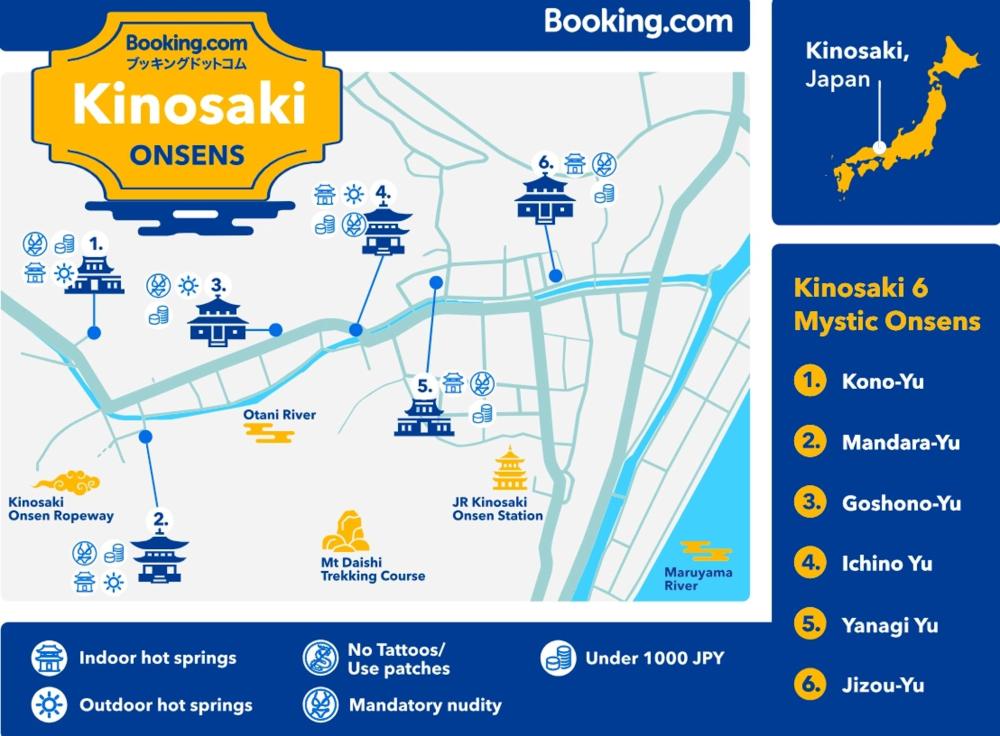
Kinosaki, Hyōgo Prefecture
Surrounded by lush green mountains and the Maruyama River, Kinosaki is renowned for being one of Japan’s ultimate hot spring towns. Steeped in over 1,300 years of history, it attracts travellers from all over the world with its serene atmosphere and several natural hot springs to choose from.
- Ideal for: couples, families and first-time visitors
- Tattoo-policy: tattoo-friendly – no size limit or cover-up
- Nudity: mandatory
- Public or private: public
- Features: both indoor and outdoor hot springs
- Cost: under 1000 JPY (6 USD) or 1,500 JPY (10 USD) for a day pass*
Why visit Kinosaki Onsen town?
Kinosaki offers an authentic experience across its variety of seven distinct bathhouses, each with its own design, atmosphere and layout – from rotenburo (outdoor baths) with mountain views at Satono-yu to the cave bath at Goshonoyu.
Many ryokans, such as Nishimuraya Honkan and Morizuya offer a town pass for access to all seven baths during your stay. The town is also a great destination to visit all year round, offering cherry blossoms in spring and fresh local Matsuba snow crab in winter (November to March) promising an authentic experience whatever time of year you decide to visit.
Good to know:
- Those staying at a local ryokan (Japanese inn) are generally given a Yumepa Pass which allows unlimited access to all seven baths
- One-day passes are available to purchase at bathhouses for day visitors
- Most bathhouses usually stay open until 23:00
- Walking through the town in yukata (cotton kimono) and geta (wooden sandals) is encouraged and part of the Kinosaki experience
Beppu, Ōita Prefecture
Located along the coast of Kyushu, Beppu is often referred to as ‘Japan’s hot spring capital’, where steam can often be seen rising from the streets and hillsides. Instead of one town, Beppu is made up of several onsen districts spread out across the city – all of which offer different bathing experiences from mud baths to sand bathing.
- Cost: 2,400 JPY (15 USD) for the full pass*
- Ideal for: families, couples and solo travellers
- Tattoo-policy: ranges from tattoo-friendly, cover-ups necessary or no tattoos in public
- Nudity: mixed – depending on facility and bath type
- Public or private: public and private options available
- Features: both indoor and outdoor hot springs
Why visit Beppu Onsen town?
Beppu offers a wide range of bathing experiences beyond the classic hot springs, including steam, mud and sand baths. A Beppu highlight is the Jigoku Meguri (Hell Tour). Most easily explored by bus, this tour visits seven distinct volcanic springs known for their striking colors – ranging from cobalt blue to blood red. Properties such as Hyotan Onsen and Kappo Ryokan Kannawa Bettei also offer private bathing facilities, so you can relax in your own exclusive setting.
As well as a wide range of experiences and activities, Beppu also offers a variety of accommodation, including:
- Traditional ryokans: like Kannawaen or Kappo Ryokan Kannawa Bettei (strictly no tattoos)
- Larger properties: such as Beppu Onsen Resort Stay SPA TSURUMI (tattoo-friendly with cover-up stickers) or Spa and Resort Hotel Solage Oita Hiji Beppuwan (tattoos must be covered).
Beppu is home to eight hot spring villages, collectively known as Beppu Hatto, and unlike smaller onsen towns, travellers will often use buses, taxis or hire a car to travel between districts.
As you explore, you will notice that each district has its own unique features:
- Kankaiji Onsen: offers a relaxed spot where travellers can enjoy a soak while enjoying panoramic views of Beppu Bay.
- Kamegawa Onsen: a peaceful seaside setting famous for its traditional sand baths where visitors wear a yukata and are buried in naturally heated volcanic sand.
- Kannawa Onsen: a district rich in history where visitors can enjoy steam baths and ryokans or try their hand at ‘hell steam cooking’, allowing guests to cook food such as eggs, seafood and vegetables in geothermal steam.
Good to know: before visiting any bath in Beppu, it is important to know that hot spring water is often around 43°C but always check with others before adding cold water. Also, unlike other parts of Japan, sitting on the edge of the bath is frowned upon.

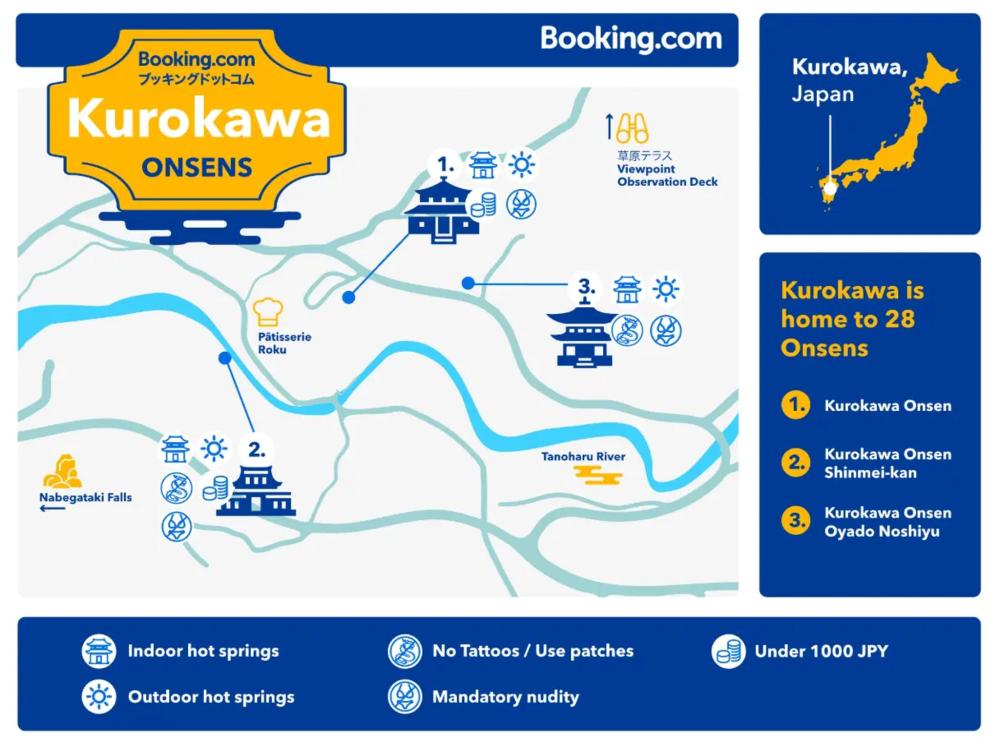
Kurokawa Onsen, Kumamoto Prefecture
Settled in the heart of Kyushu valley is where you will find the picturesque Kurokawa Onsen town. Surrounded by lush forests and located near Mount Aso, Kurokawa offers travellers a relaxing and authentic Japanese onsen experience.
- Cost: 500 JPY (3 USD) for a Tegata Pass*
- Ideal for: couples and solo travellers
- Tattoo policy: not permitted in some, permitted with patches
- Nudity: mandatory
- Public or private: public and private options available
- Features: mix-gendered onsen
Why visit Kurokawa Onsen town?
Kurokawa Onsen is unique for its commitment to preservation, banning large hotels, neon signs and bright colours – as every part of the town is designed to blend into the natural surroundings. It embraces the onsen-hopping culture with many visitors encouraged to pick up a Nyūtō Tegata pass from the visitor centre.
This wooden pass has three stickers for entry into three participating bathhouses. With many ryokans participating, the only challenge is choosing which one. Unused stickers can usually be traded for drinks, snacks or a souvenir at participating venues.
For unique bathing experiences, visit Ryonkan Shinmeikan’s cave onsen which has two-mixed gender baths and one for women. Alternatively, Ikoi Ryokan offers travellers the opportunity to experience their ‘standing bath’.
Travellers can also choose from various other ryokans, like Kurokawa Onsen Oyado Noshiyu, where guests can enjoy the traditional tea house, wooden baths and breakfast and kaiseki dinner – an authentic Japanese multi-course meal.
Kurokawa is home to approximately 26 public baths, with some outdoor baths being mixed-gendered. If you would prefer a more private onsen experience, many hotels and ryokans offer private baths that can be rented by the hour.
Unique Japanese onsens
Ubuya Onsen, Yamanashi Prefecture
Tucked away on the edge of Lake Kawaguchi and enjoying incomparable views of Mount Fuji, Ubaya onsen offers relaxation at every turn – seamlessly blending contemporary design with traditional onsen culture.
- Cost: 2,000 JPY (13 USD)*
- Ideal for: families, couples and first-time visitors
- Tattoo-policy: restrictive – mandatory tattoo patches
- Nudity: mandatory
- Public or private: public and private
- Features: both indoor and outdoor hot springs
What makes Ubuya Onsen unique?
What sets Ubuyu apart is its exceptional views and its ‘Celebrate Life’ concept, encouraging guests to mark life milestones. For celebrations, they provide traditional happi coats and handmade kusudama (decorative paper balls) containing celebratory messages.
Guests can also visit the small Shinto shrine located on the first-floor, Konohana no Yashiro, dedicated to Konohana no Sakuyahime, the goddess of Mount Fuji. Nearby, guests can leave messages of gratitude or wishes for the future on a Mount Fuji-shaped message board.
Location is key at Ubuya and its exceptional views can be appreciated from nearly all rooms, including the main bathing areas. Instead of bath-hopping around a town, guests move between different pools within the property while enjoying a gentler pace of life.
The bathhouse is set over two floors where you can choose from:
- Spacious baths
- Open-air baths
- Reclining baths
- Seated baths
- Meguriyu (a combination of seated and reclining)
Beyond baths, Ubuya also offers saunas, an on-site spa, relaxation rooms, a library, karaoke and seasonal kaiseki dining in the on-site restaurant. After a day of relaxation, why not book a stay at nearby Fuji Kawaguchiko Onsen Konansou where the Mount Fuji views continue?

Dogo Onsen, Ehime Prefecture
Renowned as one of the oldest Japanese hot springs, Dogo Onsen boasts a rich history with mentions of it in ancient texts that date back thousands of years. Located in the city of Matsuyama, the bathhouse building that still stands today was built to honor Emperor Meiji in 1894.
- Ideal for: couples and solo travellers
- Tattoo policy: tattoo-friendly – no size limit or cover-up
- Nudity: mandatory
- Public or private: public and private options available
- Features: indoor bath house
- Cost: 700–2,500 JPY (5–16 USD)* Dogo Onsen price varies significantly based on whether you just use the bath or opt for the private tatami lounge experience (a reserved relaxation room with woven straw mats and tea service)
What makes Dogo Onsen unique?
Over the years, Dogo Onsen has maintained its prominence and is also said to have been the inspiration for the main bathhouse, Aburaya, in Spirited Away, with its labyrinthine corridors, stairways and small tatami rooms.
Beyond this, Dogo is special because it preserves and allows locals and visitors to be a part of living history. Once you have your ticket you can explore the historic Honkan building, a multi-level public bathhouse built in the 19th century. Inside, you’ll find:
- Two public baths: one more rustic and referred to as Kami-no-Yu (Bath of the Gods) and one more private, Tama-no-Yu (Bath of the Spirits).
- Yushinden: otherwise known as the Imperial Family Wing which was built in the 19th century for the Imperial family who frequently visited.
- Communal tatami mat rooms: where guests can relax and enjoy a cup of tea.
Note: due to popularity, bath visits are generally capped at 60–90 minutes.
After a day of bathing, continue the relaxation at Dogo Onsen Funaya, known for its seasonal kaiseki dinners and large Japanese garden.

Family-friendly onsens
Hyotan Onsen, Oita Prefecture
Renowned as the only Michelin three-star hot spring in Japan, Hyotan Onsen offers families a relaxed bathing experience in a traditional setting on the slopes of Beppu.
- Cost: 780 JPY (5 USD)*
- Ideal for: families, solo travellers and first-time visitors
- Tattoo-policy: tattoo-friendly – no size limit or cover-up
- Nudity: mandatory
- Public or private: public and private options available
- Features: both indoor and outdoor hot spring – known for their indoor ‘waterfall’ baths
Why visit Hyotan Onsen?
Hyotan Onsen has become widely regarded as a top spot for families looking to experience traditional Japanese bathing culture in a relaxed setting. It offers 14 private family baths with visitors able to choose from eight indoor and six open-air baths. Each bath has its own theme and style, from the more nature-focused Kajika (tree frog) bath to the nostalgic Hibiki (echo), so you can choose the perfect setting for your family's soak.
Private family baths can be reserved for 90 minutes for approximately 2,400 JPY or 15 USD so you can bathe together with your loved ones. After enjoying a soak you can also enjoy use of your own private sauna in each family room
Beyond the water, Hyotan also offers DIY sand baths – which are open to all ages with supervision. These allow guests to gently bury themselves in heated sand, offering a more playful experience. After your sand bath, why not head to one of the rest areas where you can relax or play a game of cards? You can also enjoy a variety of dishes at the on-site restaurant – a children’s menu and sake is also available – as well as the steamed pudding which is made using Hyotan Onsen steam. After a day of bathing, continue your traditional experience with a stay at Kunisakisou.

Hakone Kowakien Yunessun, Kanagawa Prefecture
Offering a unique twist on Japanese onsen culture is the world-famous Hakone Kowakien Yunessun – a hot spring theme park well-suited to families.
- Ideal for: families, couples and first-time visitors
- Tattoo-policy: restrictive – mandatory tattoo patches in ‘Mori no Yu’ or swimwear zone
- Nudity: mixed – mandatory in ‘Mori no Yu’ zone
- Public or private: public and private options available
- Features: both indoor and outdoor hot springs – known for very large outdoor theme area
- Cost: 2,500–3,500 JPY (16–23 USD)*
Why visit Hakone Kowakien Yunessun?
Unlike traditional onsens where full nudity is mandatory the main Yunessun zone at Hakone Kowakien Yunessun requires visitors to wear swimsuits – children under three must wear a swim nappy. These can be purchased on-site if needed.
This fun-filled area features a variety of baths, including coffee, wine and green tea themed pools – all of which can be enjoyed by children. Other areas families can enjoy at Hakone Kowakien Yunessun include:
- Bozappy’s Yuyu Plaza: a shallow indoor pool ideal for toddlers and babies
- Pony Lagoon: a children’s pool with mini-slide and a viewing area for parents
- BOXAPPY’s Jungle Gym: a family-friendly outdoor pool area featuring slides and shallow pools
For more thrills, families can enjoy Rodeo Mountain, an outdoor pool with a water slide and God’s Aegean Sea, a spacious indoor bath. Alternatively, if the public baths become busy, private baths are available to reserve, costing approximately 7,000 JPY or 45 USD for two hours.
Out of the water, this onsen offers a dedicated nursing room, changing facilities and family-friendly dining at its restaurants, including the Fontana poolside restaurant and Hakone Buffet restaurant.
To be within easy reach of Hakone Kowakien Yunessun, enjoy a stay at a local ryokan like Hakone Kowakien Tenyu or Hakone Kowakien Miyamafurin.

Budget-friendly onsens
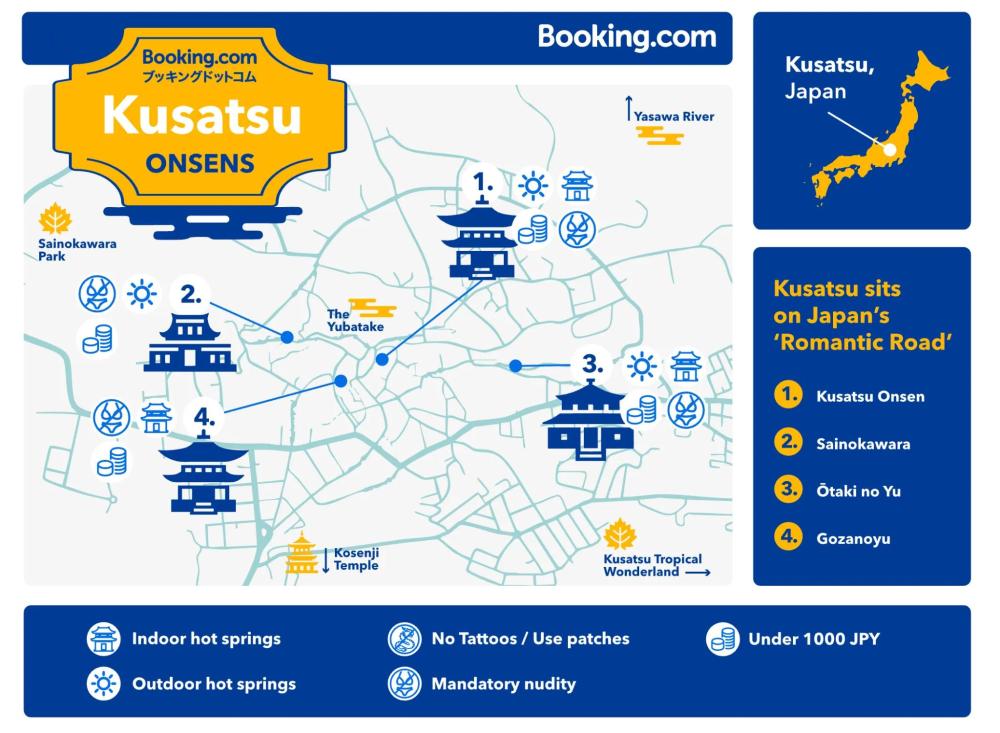
Kusatsu onsen public bathhouses, Gunma Prefecture
Settled on the edges of Joshin’etsukogen National Park is where you will find these public bathhouses – known for having the largest natural flow of hot spring water in Japan.
- Ideal for: couples and solo travellers
- Tattoo-policy: generally tattoo-friendly but varies by specific bath house
- Nudity: mandatory
- Public or private: public
- Features: both indoor and outdoor hot springs
- Cost: 700–980 JPY (5–6 USD)*
Why visit Kusatsu public bathhouses?
These public hot springs are a great option for budget-conscious travellers, as they are managed by the town for local use – but are open to visitors. Public bathhouses allow visitors to experience traditional onsen bathing without additional costs – such as hiring a private room at a ryokan.
While Kusatsu public baths are budget-friendly, be mindful that they do not require a reservation – so can be very busy, particularly during the weekends and peak seasons. It is also recommended that you bring your own towels and soap as buying them on-site may require a fee.
Kusatsu offers three different bathing experiences for visitors to enjoy, these include:
- Sainokawara Rotenburo: one of the largest open-air outdoor baths in Japan
- Otakinoyu: where guests can move through different baths of increasing heat
- Goza-no-yu: located near the Yubatake (hot water field), it offers wooden and stone tubs
If you’d prefer to soak in private, there are many ryokans that offer these facilities throughout the town, like Tokinoniwa and Urakusatsu TOU. Some ryokan will also allow non-guests to use their baths during the day time for a fee, usually between 500–1500 JPY or approximately 3–10 USD.
Arima Onsen day baths, Hyōgo Prefecture
Tucked away on the edges of Mount Rokkō, Arima Onsen is a popular, budget-friendly town and can easily be accessed from major cities like Kobe and Osaka.
- Ideal for: solo travellers, couples and families
- Tattoo-policy: strict – no tattoos allowed in public areas
- Nudity: mandatory
- Public or private: public and private
- Features: both indoor and outdoor hot springs
- Cost: 550–1,200 JPY (3–8 USD)*
Why visit Arima Onsen day baths?
As one of Japan’s oldest hot spring resorts, Arima is well-known for its distinctly coloured public baths:
- Kin no Yu: the ‘gold water’ bath enriched with iron and sodium
- Gin no Yu: the ‘silver water’ bath with clear waters and containing radium and carbonate
Both baths can be paid for individually or if you want to try both, you can buy a combined ticket which provides access to both in one trip. Ideal for budget-conscious travellers, these public baths are designed for ‘walk-in soaking’, providing a flavour of Japanese soaking culture, without the need to pay for a private room or multi-course kaiseki meal. After your bath, you can wander through the main street and try the variety of street food on offer. Some popular options include Kobe beef croquettes, soy milk donuts and onsen manju (steamed buns cooked using hot spring steam).
Although public baths can be an affordable option, they are centrally located and can become very busy – especially on weekends, holidays and during peak seasons. Facilities can also be more basic than those at high-end ryokans, but they do provide easy access and a traditional experience at great value.
Like other onsen towns, many of Arima’s ryokans will open their baths to non-staying visitors during the day for a fee that ranges from 1,000–3,000 JPY or approximately 7–20 USD*. Alternatively, head to Taiko no Yu – a hot spring theme park featuring 26 different types of baths, relaxation areas and saunas.
If the public baths are too busy, some hotels like Kamenoi Hotel Arima and Arima Grand Hotel offer day-entry where you can use their facilities.

Hot springs near Tokyo and Osaka
Hakoyu at Shuzenji Onsen, Shizoka Prefecture
The peaceful town of Shuzenji Onsen can be found approximately two hours away from the bustling sights and sounds of Tokyo. Travellers can leave the everyday behind and try onsen bathing in the town’s public bath Hakoyu.
- Ideal for: budget-conscious travellers, day-trip travellers and couples
- Tattoo-policy: small tattoos only – large ones need private onsen
- Nudity: mandatory
- Public or private: public
- Features: indoor hotspring
- Cost: 350–500 JPY (2–3 USD)*
Why visit Shuzenji Onsen?
If you’re looking for an authentic hot spring experience near Tokyo and want to see how the locals live, then Hakoyu is the place. It features one large rectangular tub filled with hot spring water that is often around 42°C.
It is a peaceful alternative to hot spring water parks or busier areas where visiting at quieter periods makes all the difference if you want a relaxed soak. There is also the opportunity to climb the nearby 12-metre wooden lookout tower after you bathe, where you can enjoy views overlooking the temple rooftops and Katsura River. Stay nearby at the traditional Shuzenji Onsen Hotel Takitei.

Nanki-Katsuura Onsen, Wakayama Prefecture
Enjoying a superb location on the southeast coast of the Kii Peninsula, Nanki-Katsuura Onsen can be found approximately four hours away from Osaka.
- Ideal for: adventure travellers, couples and solo travellers
- Tattoo-policy: strict – tattoos must be covered or use private baths
- Nudity: mandatory
- Public or private:
- Features: both indoor and outdoor hot spring – known for famous Bokido cave bath
- Cost: 1,500–2,000 JPY (10–13 USD)*
Why visit Nanki-Katsuura Onsen?
The main attraction of Nanki-Katsuura is its Bokido (Cave of the Forgotten Turtle) cave onsen which can be found at Hotel Urashima. Guests can enjoy a relaxing soak as they enjoy views of the rolling waves nearby.
Throughout the town you will find a variety of indoor and outdoor baths – including the public bathhouses of Hamayu and Nishiki-no-Yu, perfect if you want to venture away from the resort. If some bathhouses are feeling too busy, why not escape to Kumano-Bettei Nakanoshima? Set on its own private island that can be accessed by a five-minute ferry, this open-air bath is set right on the water’s edge.

Ryokan vs onsen – baths, inns, towns and spas explained
Onsen
An onsen is a traditional hot spring bath that is full of natural minerals, offering a relaxing experience for the body and mind.
Throughout Japan, you will find two types of hot springs:
- Natural onsens: otherwise known as ‘true onsens’ use geothermal water, heated by volcanic activity and rich in minerals such as calcium, sulphur and sodium. Many natural onsens include an open-air bath known as a rotenburo, where you can bathe surrounded by views of mountains, rivers and forests.
- Jinko-onsens: are artificial onsens that use heated water or natural spring water with added minerals to recreate a traditional hot spring. Artificial onsens can be found both indoors (known as uchiyu) or outdoors (rotenburo) and are usually located at large public bath houses, resorts and hotels.
Onsen towns
These are Japanese towns and villages built around hot springs and are often set in rural, coastal or mountainous areas. For many travellers, onsen towns provide an opportunity to escape the hustle and bustle of Japan’s larger cities.
Onsen towns (onsen-machi) allow travellers to immerse themselves in local culture.
Bathing is a key part of everyday life in onsen towns and it is not uncommon to see locals wandering between bathhouses and indulging in onsen-meguri (hot spring hopping).
Hotel spas
Many hotels throughout Japan offer onsen-style spas for guests to get involved in local culture without having to venture too far. These spas tend to feel more contemporary rather than the traditional hot springs in onsen towns.
Some properties will use real hot spring water piped in from nearby sources, while others will recreate the onsen experience using heated or natural spring water with added minerals. Generally, hotels offer additional facilities such as saunas, swimming pools, treatment rooms and relaxation areas – as well as private bathing rooms which can be beneficial for first time visitors and families.
Ryokans
If you’re looking for a more traditional and immersive hot spring experience in Japan then staying in a ryokan is a good bet. These traditional Japanese inns feature culture at every turn, with tatami (straw) flooring, futon beds and sliding doors.
Ryokans can feature a variety of baths including indoor, outdoor, gender exclusive and occasionally, mixed gender baths. Private baths are usually also available, but these can be smaller and may require a reservation in advance.
Besides bathing, ryokans are well-known for their multi-course dinners which feature a variety of dishes to reflect local tastes and seasonal ingredients.
Things to know before you go to an onsen
Bathing in an onsen is an experience in and of itself. Bathing nude with a group of strangers is another thing. If it’s your first time visiting an onsen, here are some helpful things to know before you dip your toes.
- Research rules around nudity: most onsens require full nudity unless specified. Make sure you do your research before visiting and check if clothing or swim attire is allowed to avoid any form of nudity.
- Look out for mix-gendered baths: onsen baths are typically separated by gender but mixed baths do exist.
- Research tattoo policies before visiting: tattoo policies can vary from one bath house to another. Check the tattoo policy before visiting an onsen as some of them have strict tattoo policies and don’t allow entry even for the smallest tattoos. Some tattoo-friendly onsens allow entry for people with small and mid-sized tattoos if they’re covered with tattoo patches or bandages.
- Keep noise down: onsens are for relaxation – speaking is not prohibited but guests are expected to respect the peace and speak quietly.
- No phones: onsens are very strict on privacy – no cameras and phones allowed in the bathing area to protect the privacy of bathers.
- No towels in water: while a small towel is often provided to bring into the bathing area, this towel is not allowed in the bathwater.
- Check the curtains (noren) before entering: at the entrance to the baths, there are coloured divider curtains called noren. These are usually red or pink for the women’s entrance (marked with the kanji 女) and blue or green for the men’s entrance (marked with the kanji 男).
Note: some onsens swap these daily to let different genders enjoy the respective views or facilities. Always check the colour and symbol every time you enter, even if you were there the night before.
- Bring coins: most onsens have lockers to store your belongings while you’re bathing. These lockers more often require coins – anywhere from 10–100 JPY. You’ll get your coin back when you leave.
- You can bring your own toiletries: onsens provide shampoo, conditioner, soap for free and occasionally towels for a price. While they provide the basics, you are allowed to bring your own toiletries.
Onsen etiquette: do’s and dont’s
Do's:
- Use the small towel to cover yourself while walking between baths
- Keep long hair tied up and out of the water
- Walk carefully as the floors can be slippery
- Greet other bathers
- Respect other bathers’ privacy
- Bring your small washcloth to the bathing area
- Be mindful and keep the noise down
Don’ts
- Don’t swim
- Don’t dive into the water
- Don’t splash in the bathing area
- Don’t take pictures of anyone
- Don’t bring food or drink into the bathing area
- Don’t stare at other bathers – it’s not polite
- Don't bring your large bath towel into the bathing area
- Don't wash or soap up in the actual onsen
A beginners guide to onsen bathing
1. Read signs before entering
Some onsens have different rules – this can vary per region and onsen. It’s always a good idea to look out for any signs to see if the onsen you’re visiting has a special set of rules.
2. Remove shoes
Shoes are not allowed in the bathing area – slippers are often provided for walking about. Be sure to leave shoes in the entrance lockers or in the dressing room.
3. Undress
Undress only in the changing room. Remember, unless specified, underwear and swim attires are not allowed in the bathing area.
4. Shower first
There’s a designated showering area to clean yourself before taking a dip – make sure to thoroughly wash your body before entering the water.
5. Dry before entering changing room
While there’s no need for a shower after your relaxing soak, it is customary to pat yourself dry before leaving the bath area. This keeps the changing room dry – be mindful not to let the towel touch the water.
How to book an onsen
Day-use onsens can be booked online or in person but some onsens are ryokan onsens and require pre-planning. In Japan, Rakuten is one of the popular websites for making reservations and while it’s local, there are a few drawbacks as a traveller. For example:
- It requires the use of translation apps for those that are not familiar with the Japanese language.
- Customer service support can be challenging to navigate in English.
- Payment options are not always clear with some ryokans requiring travellers to pay at the property in cash or struggle with foreign credit cards.
Use Booking.com for your next onsen experience
Looking for your next onsen experience? Booking.com allows you to sit back, relax and enjoy your soak. You get:
- Insights from fellow travellers through reviews and can find out how tattoo-friendly an onsen is, if it’s easy to navigate in English and other first hand experiences from global travelers.
- Customer service support is available at all times.
- All your bookings in one place.
How much does an onsen cost? Price and range
Budget
Under 1,000 JPY: get the standard public bath experience.
Mid-range
1,000–2,000 JPY: enhanced facilities or multi-bath passes.
Premium
Over 2,000 JPY: high-end resorts, theme parks, private experience or exclusive hotel baths.
FAQs
Why are tattoos not allowed in onsen?
Tattoos have a complex history in Japan, when they were previously associated with organised crime. Over time, some onsens have relaxed their rules around this or ask guests to wear tattoo covers. Although more traditional onsens still maintain a no-tattoo policy, it is always best to check with the property and take cover-ups just in case.
What do you wear in an onsen?
More often than not, you will be nude in an onsen. Most onsens have this policy in place to maintain local tradition making sure everyone is equal and focused on relaxing, as well as keeping the water as pure as possible.
Are travellers allowed in onsens?
Yes, travellers are generally welcome in Japanese onsen. Visiting an onsen is one of the best ways to experience local culture – but always remember to follow the property etiquette whilst you’re there.
If you’re unsure on the etiquette or have any questions, staff are on-hand to offer advice and guidance from everything to wear to store your things to how to tie your yukata.
How hot is an onsen?
Onsen temperatures can vary by property, but generally most waters are between 38℃ and 43℃. Many properties offer a variety of baths with slightly different temperatures, so you can usually try each one to find the most comfortable temperature.
*Disclaimer: prices shown for onsens featured in this article were accurate at the time of research (February 2026) and may vary by date, package or availability. Currency conversions are approximate and provided for guidance only; actual rates may fluctuate at the time of travel.